The Development Loop: Mastering the Lifecycle of Secure, Adaptive, and Scalable Software
For years, the software industry operated on a simple, linear premise: Design, Build, Deploy, repeat. This waterfall or basic agile approach creates a final “finished” product that, while functional at launch, is instantly obsolete. It cannot proactively secure itself, it doesn’t intuitively adapt to user needs, and it rarely scales without a catastrophic architecture overhaul.
In 2026, the complexity of the digital landscape—defined by massive data, AI integration, and instant gratification—means a static product is a reactive liability.
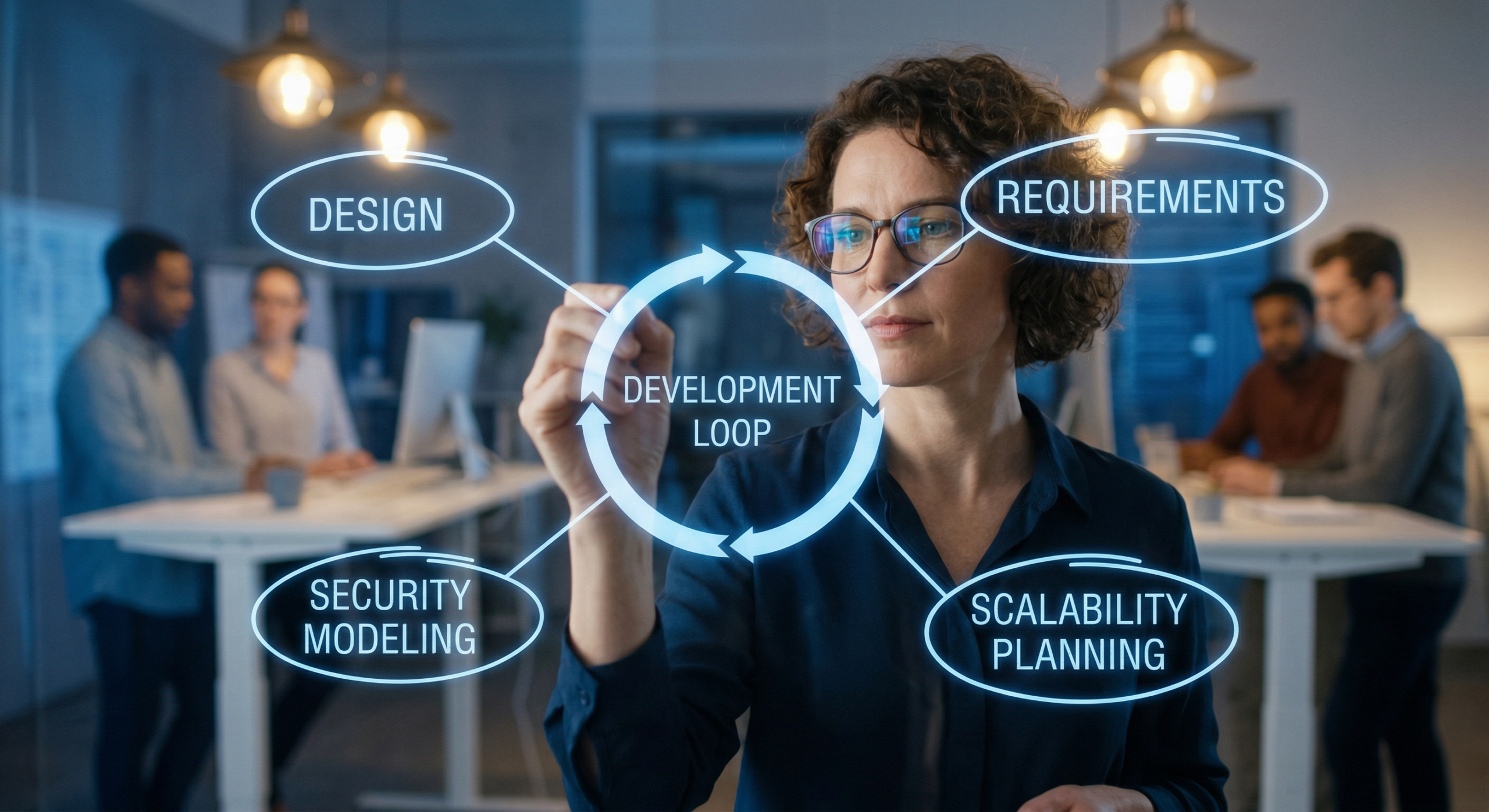
At Gigaloops, we engineer beyond the final deployment. We believe in the Infinite Development Loop: a philosophy visualized by a seamless Möbius strip of continuous motion, where every stage is a loop of constant refinement.
A living digital ecosystem requires mastering five integrated, proactive development pillars:
1. Proactive Monitoring & Security-by-Design
Traditional development often applies security patches after a vulnerability is exploited (reactive). In an adaptive lifecycle, security is not a checkbox; it is the foundation.
- Proactive approach: As shown in our lifecycle model, we build complex, geometric “Predictive Visibility” modules into the very core of the software. These abstract analysis units monitor the live environment in real-time. When a threat is detected or a database starts to show stress, the system proactively activates defensive “Light-Shields” (a form of automated self-healing infrastructure, image_4.png), isolating the issue and applying an initial security patch or rerouting traffic before users are affected or data is compromised.
2. User-Centric Feedback Loops & Adaptive Interaction
Software must work the way users think, not the way engineers code. If your WordPress gallery on a site like gigalooping.com frustrates users, they will leave. Linear models fix UI bugs only after expensive support tickets pile up.
- Proactive approach: We build “User-Centric Feedback Loops” into our agile process. The software’s interaction data is constantly analysed by predictive models. Before a UI navigation path can lead to user friction, the system generates real-time recommendations (or, in an AI-Native system, dynamically reconfigures the interface) to simplify the flow. We focus on Predictive UX (User Experience Design) to ensure the visual environment seamlessly aligns with emerging user behavior, rather than lagging behind it.
3. Iterative Agile Release & Functional Orchestration
Wait times kill innovation. When development cycles stretch into months for a single release, you lose market share.
- Proactive approach: Our development lifecycle relies on a complex, beautifully “Orchestrated Mechanism” of interlocking data cogs. This system manages thousands of code changes simultaneously. It uses intelligent automation (functional orchestration) to move small, iterative modules through the loop without disrupting the production environment. We focus on continuous iteration, releasing small, high-value improvements daily or weekly rather than once a monolithic quarter.
Summary: Engineering Living Systems
The future of IT is not about launching software; it’s about engineering resilience. By closing the loop and integrating security, feedback, and optimisation directly into the developmental infrastructure, your business stops reacting to crises and starts innovating proactively.
Is your software stuck in a rigid, linear box? Join the infinite loop and discover how GIGALOOPS can engineer a living digital ecosystem that scales with your ambition.