From Pipelines to Products: The Data Engineering Revolution in 2026
Introduction
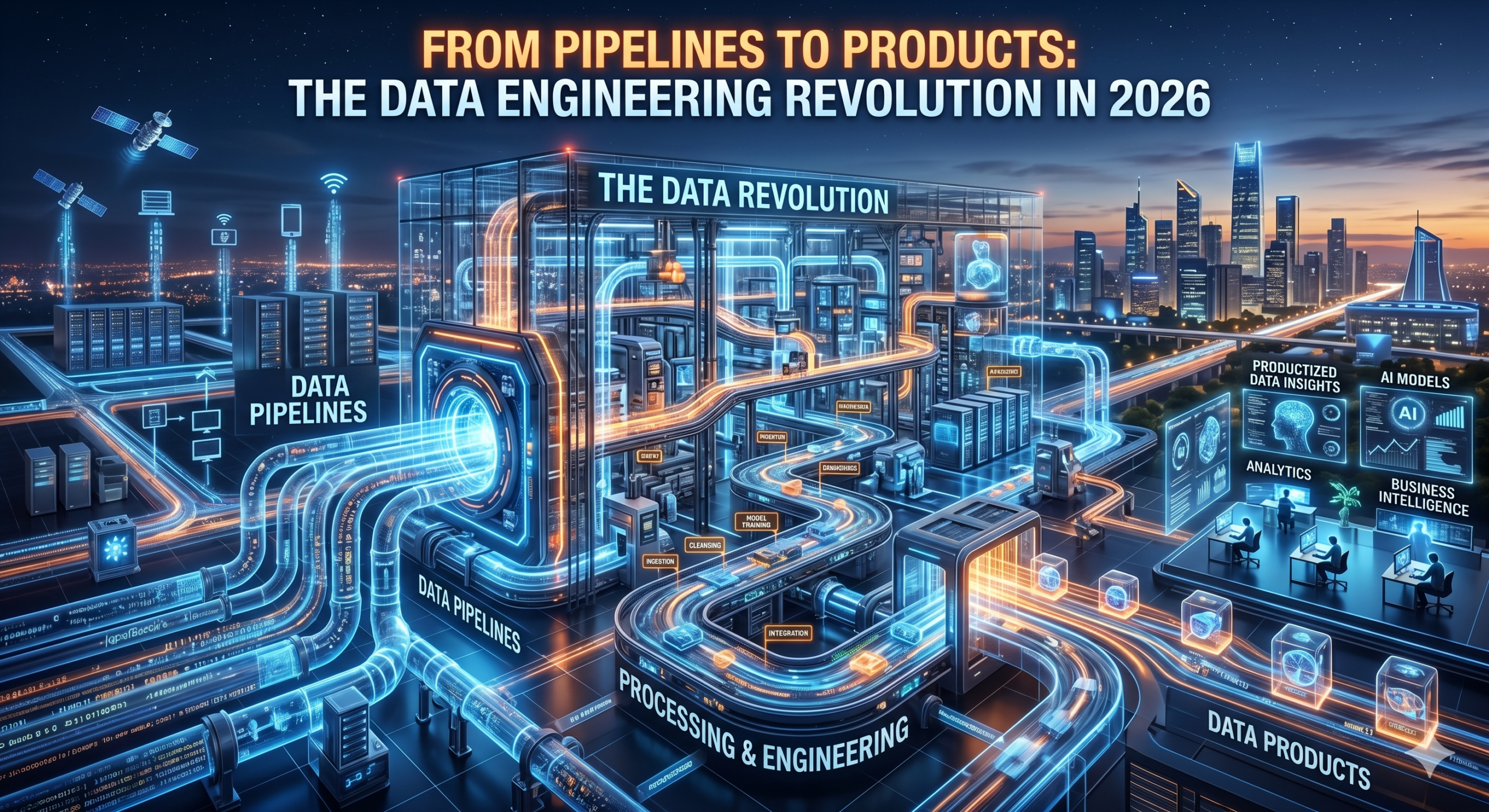
In the early days of big data, the goal was simply to move data from point A to point B without it breaking. Today, that is no longer enough. As organizations move toward decentralized architectures, the role of a Data Engineer has evolved from a “plumber” to a “product builder.” In 2026, the focus is on reliability, speed, and the democratization of high-quality data through Data Contracts and Serverless Orchestration.
1. The Implementation of Data Contracts
One of the biggest headaches for data engineers is “upstream changes”—when a software developer changes a database schema and breaks the entire downstream pipeline.
- The Solution: Data Contracts are formal agreements between data producers and consumers. They define the schema, quality levels, and SLAs.
- Why it matters: It shifts the responsibility of data quality to the source, ensuring that pipelines remain robust and predictable.
2. The Shift to Real-Time “Streaming-First” Architecture
Batch processing (running jobs once a night) is becoming a secondary option. Modern businesses demand insights in sub-seconds.
- Technologies: Tools like Apache Flink and rising “streaming databases” are replacing traditional ETL with Continuous Transformation.
- Impact: This enables instant fraud detection, dynamic pricing, and real-time recommendation engines that react to user behavior as it happens.
3. Data Mesh and Decentralization
Centralized data lakes often become “data swamps” where information goes to die.
- The Trend: Large enterprises are adopting the Data Mesh approach, where data is treated as a product and managed by the specific business domain (e.g., Marketing, Finance) that understands it best.
- The Role of the Engineer: Instead of managing all the data, central engineers now build the self-service platforms that allow these domains to manage their own data effortlessly.
4. Cost-Centric Engineering (FinOps)
With the massive scale of cloud processing, a single inefficient SQL query can cost thousands of dollars.
- Focus: Data Engineers are now expected to be FinOps-aware—optimizing partition strategies, choosing the right storage tiers (S3 Intelligent-Tiering), and utilizing serverless compute to minimize idle costs.
- Key Metric: Cost-per-query is now as important as query latency.
5. Generative AI for Metadata Management
AI isn’t just a consumer of data; it’s now a tool for the engineer.
- Usage: AI is being used to automatically generate documentation, tag sensitive PII (Personally Identifiable Information) for compliance, and even suggest optimal indexing for slow-running tables.
Conclusion
The data engineering landscape is moving away from manual maintenance toward automated, contract-driven, and cost-efficient ecosystems. By treating your data as a product and enforcing strict quality standards through contracts, you build a foundation that can support the most ambitious AI initiatives.
Are you still relying on legacy batch jobs, or has your team made the leap to streaming-first architecture?